
The everyday ingredients of Hungarian cuisine
Here you can choose from Makó red onion, purple onion, garlic, ham onion, and white onion sets. Allium varieties are a must in every vegetable garden. Read more »


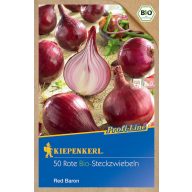


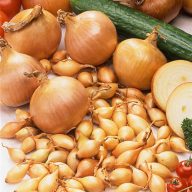


Good quality onion sets are true to variety, purebred, comply with plant health regulations, and are healthy (free from pests and their symptoms), intact (free from damage), have dry skins, are fully matured (with dried necks and dry roots), adequately firm (solid), properly sprout-free, free from foreign organic and inorganic materials, and have a characteristic onion smell. Onion sets must not be frozen, have a foreign odor, or be moldy.
The size of onion sets is generally between 10 and 30 mm. The size affects the product that can be produced from them, as larger bulbs tend to bolt early in cultivation, making them unsuitable for growing table onions.
However, larger onion sets can produce excellent green onions. For table onion production, onion sets with a diameter of 20–25 mm are usually used, and these are planted in the soil in early spring.
Garlic is a plant that can be propagated vegetatively. There are two methods of propagation. The more common is propagation by cloves (offset bulbs), but some varieties can be propagated by small bulbs, called bulbils, that develop on the flower stalk. The latter is usually only available from hobby gardeners and is not sold commercially.
The outer, large cloves of garlic can be used for propagation. Usually, the cloves are sold as propagation material, but sometimes whole heads can also be found in stores.
For garlic propagation material, it is also important that it is healthy (free from pests and their symptoms), and the cloves must be well developed, firm (solid), and sprout-free. Garlic propagation material stored for a long time and in a warm place is prone to softening and molding (Botrytis) due to water loss, so the propagation material should be kept in a dry, cool, but frost-protected place.
Frequently Asked Questions (FAQ)
1. What is good quality onion set?
Excellent onion sets are true to variety, purebred, healthy, and undamaged. The skin is dry, the neck is dried, the roots are dry, the bulb is firm and sprout-free. They must not be frozen, moldy, or have a foreign odor.
2. What size onion set should be chosen for growing table onions?
For table onion production, the ideal onion set is 20–25 mm in diameter. These produce the most beautiful, largest bulbs.
3. Why are onion sets that are too large not good for table onions?
Onion sets larger than 25 mm tend to bolt easily, so they are unsuitable for growing onions for storage.
4. What can larger onion sets be used for?
Larger onion sets can be used to grow excellent green onions, as they develop quickly and vigorously.
5. When should onion sets for table onions be planted?
Onion sets of 20–25 mm should be planted in early spring, as soon as the persistent frosts have passed.
6. How can garlic be propagated?
Garlic can be propagated vegetatively. There are two methods:
- Clove (offset bulb) propagation – this is the most common, and is how it is sold commercially,
- Bulbil propagation – small bulbs formed on the flower stalk, mainly found among hobby gardeners.
7. Which cloves are best for propagation?
The best propagation material is the outer, large cloves of garlic, as these give vigorous growth. In stores, cloves are usually sold separately packaged.
8. What is good quality garlic propagation material?
The ideal propagation material:
- is healthy and free from pests,
- contains firm, well-developed, nice cloves,
- is completely sprout-free.
Softening, shriveled, or moldy (e.g., Botrytis-infected) cloves should be avoided.
9. How should garlic propagation material be stored?
In a dry, cool, but frost-free place. If stored too warm or for too long, the cloves:
- lose water,
- begin to soften,
- easily become moldy.
A stable, cool storage environment ensures healthy and long-lasting propagation material.
10. Why is it important that onions are sprout-free before planting?
Sprouting during storage results in energy loss, so the onion will be weaker at planting, start growing more slowly, and produce a smaller yield.
11. What makes an onion set purebred?
Purity means that the onion is not genetically mixed with other varieties, so it produces a uniform crop in size, shape, and taste, which is the basis for reliable production.