Details
100% Knotted ebir.
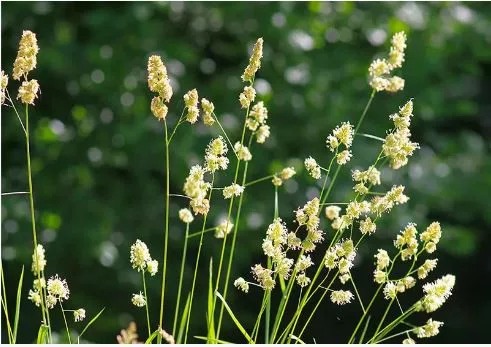
Knotted ebir is a 60-120 cm tall, densely grassy grass. Its dense, tufted root system penetrates deep into the soil, forming no tufts. It is characterised by its ability to produce 50-60 shoots a year under favourable conditions. Its sprouts remain green in winter, enclosed in the remaining leaf sheaths of the previous year's leaves, and therefore sprout in early April. The leaves are greyish green, with a closed, rough sheath, 5-10 mm wide, and the ligule is spreading. The leaf sheath is closed at first, slightly rough or smooth, flattened, with a distinctly pointed ventral and dorsal suture, and therefore strongly double-edged. The leaf blade is trough-shaped at the base, flattened above, 20-40 cm long, 5-15 mm wide, with a pointed tip. There are no auricles (auricula). At the base of the leaf-plate there is a 3-5 mm long, toothed and mostly diverging tongue. The inflorescence is unilateral, triangular, double-branched, with a compact spike, the lower branches protruding when flowering. Clusters 5-9 mm long, compressed, with 3-5 flowers. Flakes are thick, reddish, the involucre is strongly veined, curved, with two sides of unequal width, narrowing into a spike. Upper floret and involucre with stiff hairs. Fruit an eye. Flowering period from May to the end of July, sometimes until October.
Knotted ebir is a loose-bushy stolonifer, early spring emergent, prolific.
It has a lifespan of 4-6 years. It has excellent shade tolerance.
Good drought tolerance. It survives long after planting in drought areas.
It is aggressive, cattail, clinging and very suppressive.
In the lawn, it thus forms clumps. This should be taken into account when planting.
When young, it is readily grazed by animals (cattle, sheep), but it quickly becomes woody, the grass becomes coarse and its flavour deteriorates when it is no longer eaten by animals.
Next to the reed canary grass, the clumped ebir has the longest life span, able to grow for 4-8 years even in difficult conditions.
Its feeding value is second only to that of eel perch.
Reviews
Be the first to write a review!