Homemade use:
10 g/10 l water
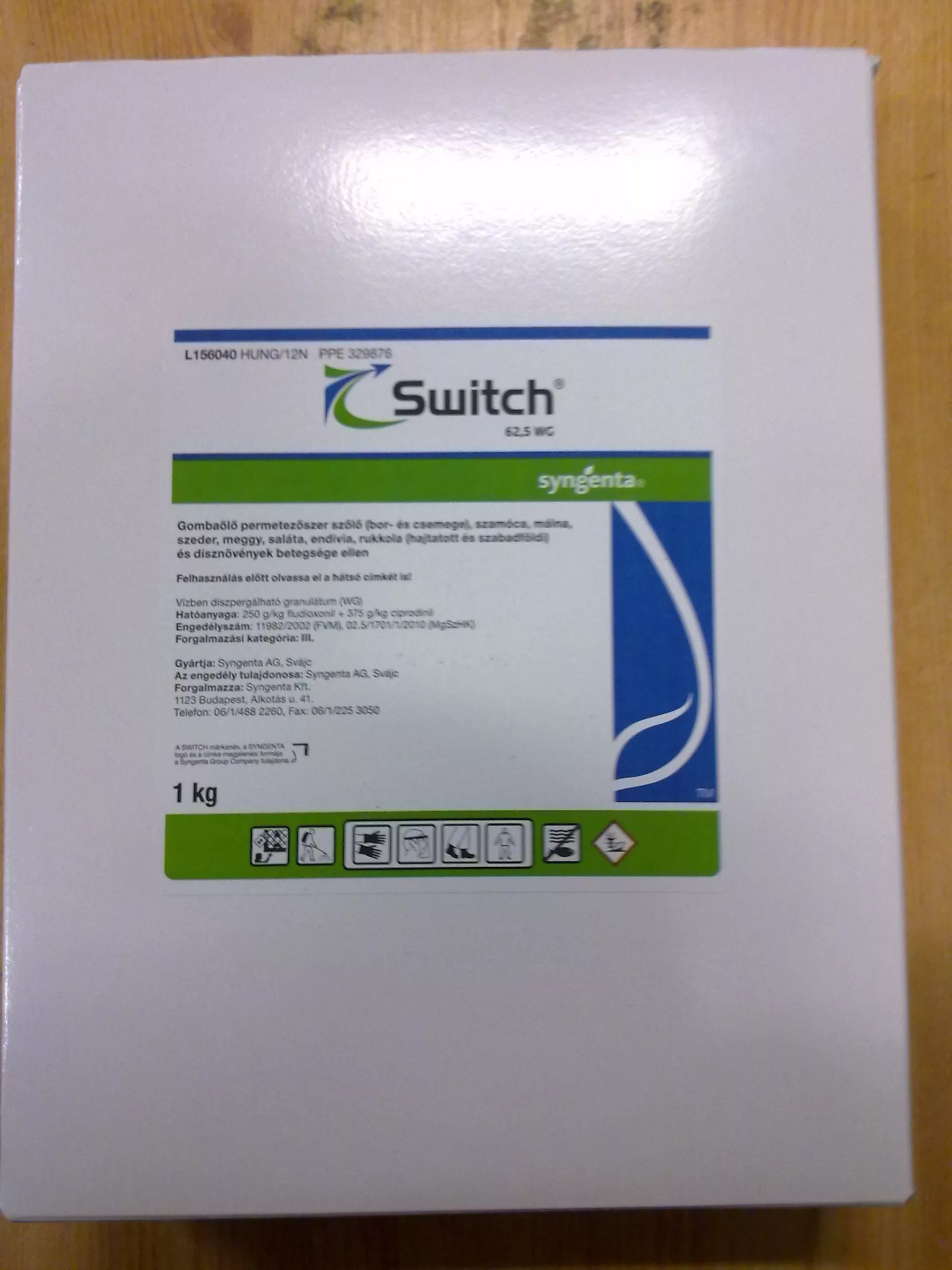
SWITCH 62,5 WG fungicide
Switch 62,5 WG is a real big gun. A dual absorption fungicide with outstanding efficacy.
What can Switch 62,5 WG be used against?
- Stone fruit flower monilias,
- grape bunch rot,
- leaf diseases of turfgrass,
- grey mould disease of ornamental flowers,
- storage diseases of fruits, and
- leaf diseases of vegetables and herbs.
The product can block the infection and leaves no stain when sprayed on the plant/fruit.
Active ingredients, formulation:
Active ingredient content:
250 g/kg fludioxonil + 375 g/kg cyprodinil | Formulation:
WG (water dispersible granules) |
Active substance family:
phenylpirole, aniline-pyrimidine | Environmental classification:
Very dangerous for aquatic organisms.
Bee hazard: not to be labelled. |
Circulation category:
III (free circulation) | Packaging:
10 g |
Use:
Household use:
- Strawberries, lentils, chickpeas, broad beans, celeriac, parsnips, onions, garlic, shallots and spring onions: 20 g/10 litres,
- lawns, turf, golf courses and football pitches: 10 g/100m2
- for all other authorised crops: 10-15 g/10 litres.
Occupational health withdrawal period: 0 days
Food health withdrawal period: according to table
Prescribed crop protection technology
In authorised crops, spraying should always be applied preventively and at the latest at the first symptoms.
In vines (wine, table grapes):
Use against grey mould disease at bunch closure and before ripening. The spray must then be directed specifically to the cluster zone .
In strawberries:
For grey mould disease, it is advisable to apply the preparation at the beginning and end of flowering.
In raspberries and blackberries:
Control should be started at the beginning of flowering.
In stone fruit (cherry, sour cherry, plum, peach, apricot):
The preparation should be applied at the beginning and end of flowering against moniliaceae.
In apple orchards (apples, pears, quince, naspolya):
Control of storage diseases should be applied once or twice at the beginning of ripening.
In bodzas:
Gray mold and stem canker are recommended to be applied during the flowering period until the beginning of ripening.
In ornamentals:
Controls should be concentrated on protecting the bracts, shoots and flower parts, spraying no later than the onset of symptoms. The use of an adhesive is recommended. The product can be applied by both cold and warm mist machines.
In lettuce crops, shoot and field (lettuce, endive, peppercorns (arugula)) and Swiss chard:
Spraying against grey and white moulds should be carried out immediately when the seedlings are pricked into the seedling nursery pots or after planting and repeated after 10 days.
In cantaloupe:
Spraying for colletotrihum (blight), cladosporium and didymellosis is carried out during the period of vine growth. Spraying for white mould is carried out immediately after the seedlings are pricked into the seedling nursery or planted out, and repeated 10 days later.
In sorrel and spinach:
Control is recommended after harvest when 4-8 leaves are present.
In lawns and turf:
Use as a preventive treatment against snowdrops in late autumn on frost-free days. Treatment should be repeated in February-March where brown patches of grass have died back. In summer, control of Rust diseases and leaf spot should be started at the first symptoms and repeated depending on the infestation threat.
Doses, use:
Culture Pest Maximum number of treatments Minimum duration between two treatments
(days) Dose (kg/ha) Spray liquid (l/ha) Treatment time
(according to phenological status)
| grapes (wine, table) | grey mould | 2 | 14 | 0,8-1,0 | 400-1000 | from flowering (BBCH 60)
to the beginning of ripening (BBCH 81) |
| vine (wine, table grapes) cluster zone management | | 0,4-0,5 | 300-500 |
| strawberries | grey mould | 2 | 10 | 1,0 | 500-600 | from first flowering
(BBCH 55)
to 1 week before harvest
(BBCH 86) |
| raspberry, blackberry | grey mould | 3 | 7 | 1,0 | 500-1500 | from the beginning of flowering (BBCH 61)
until 2 weeks before harvest
(BBCH 84) |
stone fruit
(cherries, sour cherries, peaches, apricots) | monilia | 2 | 7 | 0,8-1,0 | 600-1500 | from first flower opening
(BBCH 61)
to 1 week before harvest
(BBCH 86) |
| plum | 10 |
| apple fruit | | | | | | from the beginning of flowering |
| (apples, pears, quince, blackberries) | storage diseases | 2 | 6 | 0,8 | 500-1500 | (BBCH 61)
1 week before harvest |
| | | | | | (BBCH 86) |
Salad vegetables
(lettuce, endive, peppercorns (arugula)) | grey mustard, white mustard | 2 | 10 | 0,6 | sprouted: 800-1200
free-range: | From 1 leaf stage
(BBCH 11)
to final head size |
| (grafted, open field) | | | | | 400-600 | (BBCH 49) |
| | | | | | 1 from leaf condition |
| chard | grey mould, white mould | 2 | 10 | 0,6 | 400-600 | (BBCH 11)
up to 50%
stem thickness |
| | | | | | (BBCH 45) |
| ornamental plants | grey fungus | 3 | 14 | 0,8-1,0 | 500-1200 | no limitation |
| | | | | | from the appearance of the first flower buds |
lentils,
chickpeas, broad beans | grey mould, white mould,
ascohytosis disease | 2 | 10 | 1,0 | 300-800 | (BBCH 51)
bean eyes bulging to the pod stage |
| | | | | | (BBCH 79) |
egg fruit
(sprouted) | grey mold | 2 | 10 | 0,8-1,0 | 500-1500 | From opening of flower 7 (BBCH 67)
to the beginning of ripening
(BBCH 81) |
| courgettes | grey mould | 2 | 10 | 0,8-1,0 | 500-1200 | 1 from mature fruiting stage
(BBCH 71)
to fruiting stage (BBCH 79) |
| celeriac | alternaria
leaf spot, powdery mildew, white mould | 2 | 14 | 1,0 | 300-800 | From 4 leaf stage
(BBCH 14)
Up to 70% root thickness
(BBCH 47) |
| parsnips | | 3 | 0,8 |
| root parsley | alternaria
leaf spot, powdery mildew, white mould | 2 | 14 | 0,8-1,0 | 300-800 | 4 leaf stage
(BBCH 14)
up to 70% root thickness
(BBCH 47) |
| carrots |
onions, garlic, shallots
(sprouted,
open field) | grey mold, white mold, alternaria
disease | 2 | 14 | 1,0 | sprouted: 300-1000
free-range: 300-600 | From 10th leaf emergence
(BBCH 20)
until the beginning of drooping (BBCH 47) |
Spring onion
(sprouted,
outdoor) | From 5th leaf
(BBCH 15)
until the beginning of fall |
| | | | | | (BBCH 47) |
green
herbs | | | | | | |
(chives, chives-parsley,
dill, celery, angelica, lesty, tarragon,
peppermint,
tarragon, sage, hyssop, thyme, lemongrass, rosemary, coriander,
basil, mint,
marjoram, succulent turmeric) | grey mold, white mold, alternaria, powdery mildew | 2 | 10 | 0,6 | 200-1000 | early
from flower development
to 2 weeks before harvest |
| cattail | | 3 | | | | |
| white mould, | | | | | |
| cantaloupe (sprouted) | colletotrihum disease
(blight), cladospore disease
, | 2 | 10 | 1,0 | 600-1200 | from start of vine growth (BBCH
21) to start of ripening (BBCH 81) |
| didimellar disease | | | | | |
| bodza | leaf spot (Cercospora sp. Phoma sp.)
grey mould,
stem canker (Colletotrichum sp., Phoma sp., Fusarium sp.) | 3 | 10 | 1,0 | 400-1000 | post-harvest (BBCH
90) to early maturity (BBCH 81) |
| spinach, sorrel | powdery mildew, rust | 2 | 10 | 0,6-0,8 | 300-600 | From 4 leaf stage
(BBCH 14)
14 days before harvest |
| asparagus | rust | 3 | 10 | 0,8-1,0 | 400-800 | after harvesting asparagus shoots
until the end of stem growth |
| lawns, lawns, golf courses and football pitches | snowdrops,
leaf spot and rust | 2 | 14 | 1,0 | 300-600 | established turf
from condition (BBCH 29) |
Food waiting time:
Culture waiting time (days)
| vine (wine) | 21 |
| grapes (table) | 35 |
| strawberries | 3 |
| raspberries, blackberries | 10 |
| stone fruit (cherries, sour cherries, peaches, apricots) | 7 |
| plums | 7 |
| apple fruit (apples, pears, quinces, naspolya) | 3 |
lettuce (lettuce, endive, arugula)
(sprouted, open field) | 7 |
| Swiss chard | 14 |
| lentils, chick peas, broad beans | 28 |
| egg fruit (sprouted) | 3 |
| courgettes | 3 |
| celeriac | 14 |
| parsnips | 7 |
onions, garlic, shallots
(sprouted, open field) | 14 |
| spring onions (sprouted, field) | 14 |
green herbs
(chives, chives-parsley, dill, celery, angelica, lesty, tarragon, peppermint,
tarragon, sage, hyssop, thyme, lemon balm, rosemary, coriander, basil, mint, marjoram, succulent turmeric) | 14 |
| cat's-root | 7 |
| elderberries | 28 |
| carrots, root parsley | 7 |
| cantaloupe (sprouted) | 3 |
| spinach, sorrel | 7 |
| asparagus | not required for normal use |
| lawn, golf course | Not required for normal use |