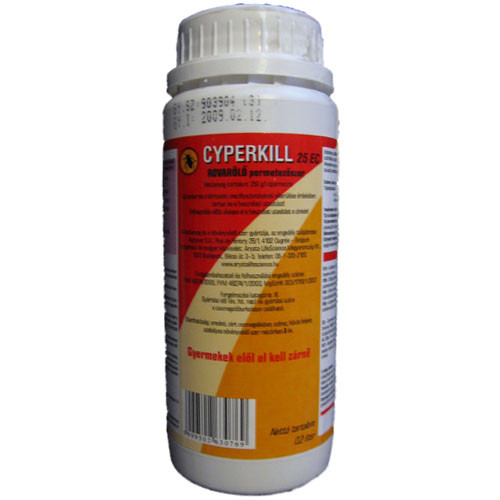
Cyperkill 25 EC 0.2 l

Home use: 2 ml/10 l water Contact and stomach poison, paralyses central and peripheral nerve cells. The effect is rapid (disarticulating). Insects become locomotivated and then die. The active ingredient in Cyperkill 25 EC is a mixture of 8 optical iso...
Item number: 
T00502
Data
Pesticide distribution category:
Manufacturer:
Width:
0.000000 cm
Height:
0.000000 cm
Length:
0.000000 cm
Availability:
1-4 nap
Sales unit:
db
Delivery availability:
1-5 nap
Veszély:
Óvintézkedésre vonatkozó P mondatok:

P102 - Gyermekektől elzárva tartandó
P210 - Hőtől, nyílt lángtól, szikrától távol tartandó. Tilos a dohányzás
P270 - A termék használata közben tilos enni, inni vagy dohányozni
P280 - szemvédő, arcvédő, védőruha, Védőkesztyű használata kötelező
P310 - Azonnal forduljon TOXIKOLÓGIAI KÖZPONTHOZ vagy orvoshoz
P304+P340 - BELÉLEGZÉS ESETÉN: Az érintett személyt friss levegőre kell vinni és olyan
nyugalmi testhelyzetbe kell helyezni, hogy könnyen tudjon lélegezni
P331 - TILOS hánytatni
P501 - A tartalom/edény elhelyezése hulladékként: Után fecske

Óvintézkedésre vonatkozó H mondatok:

H226 - Tűzveszélyes folyadék és gőz
H302 - Lenyelve ártalmas
H304 - Lenyelve és a légutakba kerülve halálos lehet
H315 - Bőrirritáló hatású
H318 - Súlyos szemkárosodást okoz
H335 - Légúti irritációt okozhat
H336 - Álmosságot vagy szédülést okozhat
H410 - Nagyon mérgező a vízi élővilágra, hosszan tartó károsodást okoz

Óvintézkedésre vonatkozó EUH mondatok:

EUH401 - Az emberi egészség és a környezet veszélyeztetésének elkerülése érdekében be
kell tartani a használati utasítás előírásait

Weight:
200 g/db
Points earned after purchase:
66 Ft
Details
Home use: 2 ml/10 l water

Contact and stomach poison, paralyses central and peripheral nerve cells. The effect is rapid (disarticulating). Insects become locomotivated and then die.

The active ingredient in Cyperkill 25 EC is a mixture of 8 optical isomers of cypermethrin. This makes Cyperkill 25 EC highly effective in conditions where preparations containing only a few of the 8 isomers are less effective (e.g. because the insects have become resistant to these isomers).


Approved cultures, pests, other data
Culture Pests Dose Water volume (l/ha) YEAR
Cereal grasses Seed-whitening beetle larvae, leafminers 0,15 l/ha 300-500 10 days

Grapevine vine weevils 0,15 - 0,2 l/ha 800 - 1000 10 days
Apple cider moth 0,15 - 0,2 l/ha 500 - 1000 3 days
Oilseed rape Rape beetle 0,15 l/ha 300 - 400 10 days

Peppers, tomatoes
green peach aphid,
cotton aphid, green house aphid 0,2 l/ha 500 - 1500 3 days


Technological recommendations

In cereals: control of seed-feeding beetles should be carried out when the pest is mass established or during the main period of larval emergence. For cereal aphids, it is recommended to apply the product at the time of the first colonies.

In oilseed rape: control of oilseed rape beetle and oilseed rape weevil should be carried out at the time of imago infestation.

In apples: control of apple fruit fly should be started at the time of larval emergence, based on a forecast. In case of prolonged swarming, 2-3 treatments per generation may be necessary. Higher doses are recommended for late control.

In grapes: treatments against grapevine moths based on sex pheromone trapping predictions should be carried out 1-2 times per generation after main swarming against young larvae. In case of prolonged swarming, it is recommended to repeat the treatments after 7-10 days. The effectiveness of the control measures is favourably influenced by timely and well-executed greenwork.

In field peppers and tomatoes: treatments against green peach aphid should be started on the basis of a yellow vein observation after the first individuals have established, before small colonies have formed, and repeated during the period of colonisation.

In sliced peppers and tomatoes: treatments against greenhouse mealybugs should be started before the first small colonies are established. The product is primarily effective against young L1 and L2 larvae. Controls should be targeted at the imago and young larvae and treatments should be repeated several times. Controls against cotton owl aphid should be repeated every 5-7 days, based on a forecast, at the generative stage of the crop.

The addition of a wetting agent to the preparation is recommended.
Reviews
Be the first to write a review!
Language and currency
Loading...
Loading...
Sign in
or
Forgot password
Cart
Go to cart
Loading...
Categories
Menu items